
The Unconquered Story of Murud Janjira Fort: The Siddis, Shivaji Maharaj and the Battle for the Konkan Sea

Rising from the Arabian Sea off Maharashtra’s Konkan coast, Murud Janjira Fort looks almost inseparable from the rock beneath it. Its high stone walls, rounded bastions and carefully concealed entrance protected a naval power that resisted some of the strongest forces in western India.
The history of Murud Janjira Fort is often reduced to a single line: Chhatrapati Shivaji Maharaj tried repeatedly to capture it but could not.
The complete story is far more fascinating. It begins with a wooden refuge built by a local fishing community, continues through the rise of African-origin Siddi commanders in the Deccan, and develops into a long contest for control of the Konkan coast.
It is also the story of Padmadurg. the second sea fort Chhatrapati Shivaji Maharaj built near Janjira to contain its power and why even that bold strategy could not immediately break the Siddi stronghold.
How Old Is Murud Janjira Fort?
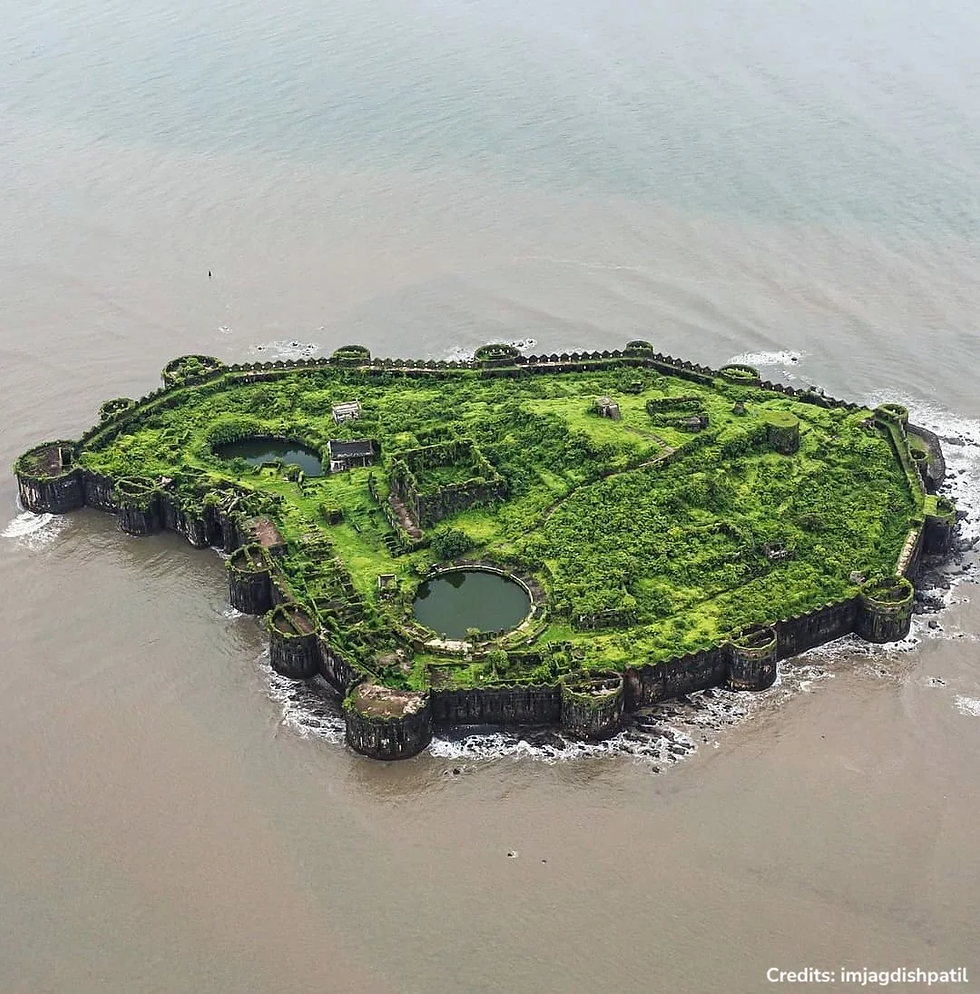
The fortified history of the island dates to the late fifteenth century, making the site more than 500 years old. According to the widely accepted account, local Koli fishermen built a small wooden defensive structure on the rock to protect their community from pirates and raiders. This early fortification is commonly remembered as Medhekot.
The island stood close to Rajapuri, an important coastal settlement and trading point. Its position made it valuable not only to local communities but also to the rulers of the Ahmadnagar Sultanate, who wanted greater control over the port and surrounding waters.
The wooden fort was eventually captured by forces serving Ahmadnagar. A popular later account describes a commander named Piram Khan entering through a ruse rather than a direct assault, although the precise details belong partly to local tradition and cannot be verified with certainty. During the sixteenth century, the wooden stockade gave way to a much stronger stone fort. Sources differ over the person who should receive primary credit. Maharashtra Tourism associates the stone fortification with Malik Ambar and dates the transformation to 1567, while other historical accounts credit Burhan Khan with commissioning the structure and place its completion around 1571.
The safest historical conclusion is that Janjira was established as a major Nizam Shahi stone stronghold during the second half of the sixteenth century. That makes its stone phase approximately 455 years old today. The fort was expanded and modified over later generations, so the surviving Murud Janjira Fort reflects several periods of construction rather than one single building campaign.
How the Siddis Came to India

The Siddis did not arrive in India as one army or during one invasion. Their presence developed over centuries through the maritime routes connecting East Africa, Arabia and the western coast of India.
The term “Habshi” was historically connected to al-Habash, a region associated with Abyssinia and parts of present-day Ethiopia, Eritrea and Sudan. “Siddi” became another widely used name for communities of African descent in India.From the medieval period onwards, Africans crossed the Indian Ocean in different circumstances. Some were brought through systems of enslavement, while others arrived as sailors, merchants, soldiers or military recruits. Their experience in India was not uniform. Many served in households and armies, but some rose to positions of considerable political and military authority in the Deccan.
The most famous example was Malik Ambar, who was born in the Horn of Africa, sold into slavery, brought to the Deccan and eventually became the powerful regent of the Ahmadnagar Sultanate. His career demonstrates the extraordinary, though uncommon, mobility achieved by some African military elites in medieval India. Siddi commanders were appointed to positions at Janjira under the Nizam Shahs. Historian Pushkar Sohoni records that Malik Ambar appointed Siddi officers to command the fort in the early seventeenth century. In 1621, Siddi Ambar Sanak became its commander. From that point until Janjira State merged with the Indian Union in 1948, the fort remained under a Siddi ruling dynasty.
Their formal allegiance shifted with the politics of the Deccan, from Ahmadnagar to Bijapur and later towards the Mughal Empire, but the Siddis exercised substantial autonomy from their island capital.
Why Janjira Mattered to Chhatrapati Shivaji Maharaj
As Chhatrapati Shivaji Maharaj expanded Swarajya across the Konkan, Janjira represented both a strategic obstacle and a continuing security threat. The Siddis possessed a capable navy and controlled an exceptionally secure base close to important coastal routes. From Janjira, their vessels could operate along the Konkan coast, threaten Maratha-held territory, interrupt shipping and retreat behind fortifications that were extremely difficult to attack.
For Chhatrapati Shivaji Maharaj, securing the coast was essential. His vision of Swarajya was not limited to forts and territory on land; it required ports, ships, protected trade and the ability to resist hostile naval powers. Janjira stood directly against that objective.
The struggle was therefore larger than a personal contest between two rulers. It was a battle for maritime control of the Konkan.
Shivaji Maharaj’s Attempts to Capture Murud Janjira Fort

Maratha pressure on the Siddi territories developed through several campaigns during Shivaji Maharaj’s reign. Armies captured surrounding positions and repeatedly attempted to isolate Janjira, but taking land around the fortress was not the same as taking the island itself. Popular retellings often claim that Chhatrapati Shivaji Maharaj attacked Janjira exactly 13 times. While several attempts are well established, the precise number varies across later accounts and should not be treated as certain. One of the largest efforts came in 1676, when Peshwa Moropant Trimbak Pingle led a substantial Maratha force against Janjira. The Marathas tried to tighten the siege and create ways of reaching or scaling the fort. The operation failed to breach the defences, and the Siddi forces were able to disrupt the attack.
Yet Shivaji Maharaj did not respond to failure by abandoning the sea. He responded by creating a new strategic position.
Padmadurg: The Fort Built to Challenge Janjira

In 1676, Chhatrapati Shivaji Maharaj built one of the most unque forts, Padmadurg, also known as Kasa Fort, on another rocky island a little under four kilometres northwest of Murud Janjira Fort.
Padmadurg was intended to function as a forward naval base and help blockade or contain Janjira. From this position, the Marathas could watch Siddi movements, support their own vessels and place pressure on the approaches to the larger fortress. A letter written by Shivaji Maharaj in 1677 reportedly emphasised
Padmadurg’s importance and the need to maintain its logistical support.
The construction of a second fort in open water was an ambitious answer to a difficult problem. It also demonstrated Shivaji Maharaj’s understanding that a powerful island stronghold could not be defeated by land warfare alone.
However, Padmadurg did not make Janjira fall. It strengthened the Maratha presence at sea and restricted the Siddis, but it could not create a permanent and complete blockade. Janjira continued to receive the protection and resources required to survive.
Why Chhatrapati Shivaji Maharaj Could Not Capture Janjira
Janjira survived not because of one secret or one failed Maratha decision, but because several defensive advantages worked together.
1. The Sea Was Its First Wall
Before an attacker reached the stone fortifications, they had to cross exposed and changing waters. Tides, currents, waves and rocky shallows made large-scale assaults difficult to coordinate. Troops approaching in boats were vulnerable before they could establish themselves at the base of the walls.
2. The Fort Was Designed to Hide and Punish an Approach

The main entrance faces Rajapuri but remains difficult to see until a vessel comes close. Attackers could not easily identify a direct path from a distance. Once within range, they faced high walls, rounded bastions and cannon fire from multiple positions.
The walls rose roughly 40 feet above the waterline, making ladders and direct scaling operations extremely dangerous. The fort’s shape allowed defenders to observe and fire upon boats approaching from different directions.
3. Janjira Could Survive a Siege
An island fortress is useless if its defenders quickly run out of water. Janjira overcame this weakness with freshwater reservoirs inside the fort, along with spaces for storing food, weapons and ammunition. These facilities allowed the garrison and resident community to endure periods of isolation.
4. The Siddis Were Experienced Seafarers
The defenders were not simply soldiers protected by strong walls. They possessed generations of maritime experience and maintained an effective naval force. They understood the local waters, could counter blockades and could attack the vessels and floating positions used by besieging armies.
5. Janjira Was Not Politically Isolated
The Siddis survived by navigating the rivalries among the Deccan sultanates, the Mughals and European powers on the western coast. By the 1670s, their naval capability had earned Mughal patronage. Access to outside protection, supplies and friendly ports made it difficult for the Marathas to seal the fort completely.
6. The Marathas Were Fighting on Several Fronts
Chhatrapati Shivaji Maharaj was simultaneously managing conflicts and diplomacy involving the Mughals, Bijapur, the Portuguese and the English. Maintaining a long naval blockade required ships, provisions, coastal bases and uninterrupted attention. Janjira’s defenders could afford to remain behind their walls; the Marathas could not concentrate every resource on one island indefinitely.
Do Not Confuse Shivaji Maharaj’s Campaign with Sambhaji Maharaj’s Siege
Another dramatic attempt occurred in 1682, after the death of Chhatrapati Shivaji Maharaj, under his son Chhatrapati Sambhaji Maharaj.
During this later siege, the Marathas attempted infiltration and began filling part of the channel with stone and debris to create an approach towards the island. Sambhaji Maharaj was then compelled to redirect his attention as Mughal forces intensified their operations in the Konkan. The siege eventually collapsed. This episode is sometimes incorrectly added to Shivaji Maharaj’s own campaign. It belongs to the next chapter of the Maratha–Siddi conflict and shows how Janjira’s geography and external alliances continued to protect it.
The Legacy of the Unconquered Fort

Murud Janjira Fort was never successfully taken by military assault. Siddi rule continued through changing alliances and the period of British paramountcy until the princely state merged with independent India in 1948.
Calling Janjira “unconquered,” however, should not turn its history into a simplistic story of one side’s victory and another’s failure. The fort represents the maritime skill and political resilience of the Siddis.
At the same time, the construction of Padmadurg reveals the adaptability and naval ambition of Chhatrapati Shivaji Maharaj. Unable to capture Janjira through conventional means, Shivaji Maharaj built a rival sea fort, expanded naval infrastructure and continued developing a maritime strategy for Swarajya. The contest helped shape the military landscape of the Konkan and underlined a lesson that remains visible today: whoever wished to control this coast also had to command the sea.
Standing inside Murud Janjira Fort today, surrounded by the Arabian Sea, it becomes easy to understand why the fortress resisted so many attacks. Its survival was the result of geography, engineering, naval strength, supplies, alliances and determined defenders, all working together across centuries.
For travellers exploring the Konkan, Murud Janjira Fort is more than a monument. It is one of India’s most compelling chapters of African, Deccani and Maratha history, preserved on an island of stone.
Kaizan is coming soon to Murud, offering travellers a new nature-led base from which to discover the landscapes, stories and heritage of the Konkan.